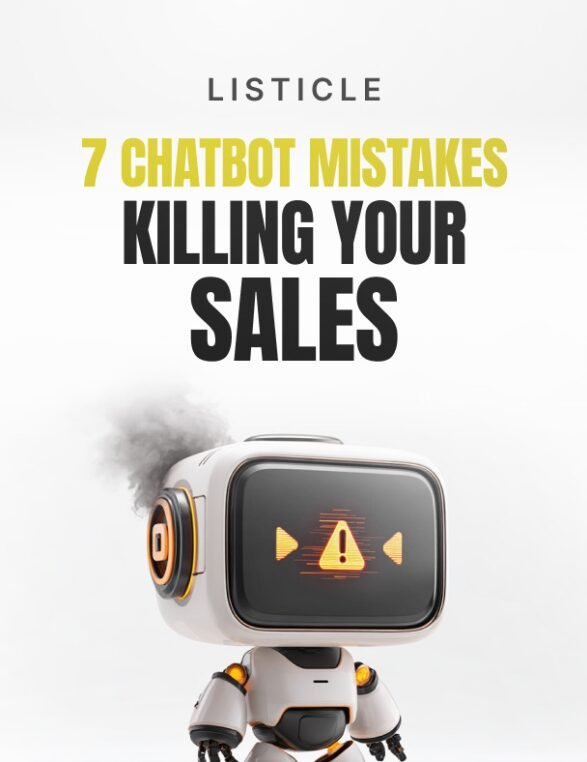
7 Chatbot Mistakes Killing Your Sales is a sharp, practical listicle guide that reveals why your chatbot is losing leads, reducing conversions, and silently costing you revenue. Instead of complex tech fixes, this guide focuses on real conversation psychology—showing you how to turn automated chats into high-converting sales flows.
7 critical chatbot mistakesthat cause drop-offs and lost leads.
Simple, practical fixesto improve engagement and conversions fast.
Conversion-focused chat flow strategiesthat feel natural and human.
Instant PDF download • Secure checkout • 7-day refund
7 Chatbot Mistakes Killing Your Sales breaks down the hidden reasons your chatbot is failing to convert—and how to fix it without rebuilding everything. This guide focuses on the real driver of conversions: conversation. Through clear examples and actionable fixes, you’ll learn how to transform robotic, ineffective chat flows into natural, persuasive interactions that move leads toward action.
What You Get
Complete listicle ebook (PDF)
Contents
1. Why chatbots fail despite correct setup
2. Mistake #1: Robotic and unnatural conversations
3. Mistake #2: Overloading users with questions
4. Mistake #3: No clear direction or next step
5. Mistake #4: Ignoring timing and response flow
6. Mistake #5: Lack of personalization
7. Mistake #6: Breaking trust during conversations
8. Mistake #7: Failing to guide toward conversion
9. Fix frameworks: turning chats into sales systems
Why This Guide Matters
Most chatbot setups focus on automation instead of conversion. The result? Conversations that feel mechanical, confuse users, and cause silent drop-offs. 7 Chatbot Mistakes Killing Your Sales focuses on behavioral conversion design—helping you reduce friction, guide decisions, and turn conversations into measurable revenue.
Features
Listicle-style learning for fast understanding and quick implementation
Real-world scenarios based on actual chatbot failures
Actionable fixes you can apply immediately without technical complexity
Who This Guide Is For
Ecommerce store owners using chat automation
Service providers and agencies generating leads
Entrepreneurs using WhatsApp, Instagram, or Messenger bots
Anyone struggling with low chatbot conversion rates
Format & Delivery
Instant PDF download after purchase. The book link sent to your email and can also be accessed in My Books page.
Sample
Read a free preview section above to see how each mistake is broken down and fixed.
Customer Guarantee
LearnStalk Promise: Instant PDF access • 7-day refund • Support via messaging. If you don’t see clear value, contact us and we’ll resolve it.
FAQs
How will I receive the book? Instant PDF link after purchase; check spam if you don’t see the email. It can also be accessed in My Books page, link below
What formats? PDF (standard).
Refunds? 7-day refund policy, read refund and return policy below — contact support with order number.
Used to determine whether a user is included in an A / B or Multivariate test.
18 months
_ga
ID used to identify users
2 years
_gali
Used by Google Analytics to determine which links on a page are being clicked
30 seconds
_ga_
ID used to identify users
2 years
_gid
ID used to identify users for 24 hours after last activity
24 hours
_gat
Used to monitor number of Google Analytics server requests when using Google Tag Manager
1 minute
_gac_
Contains information related to marketing campaigns of the user. These are shared with Google AdWords / Google Ads when the Google Ads and Google Analytics accounts are linked together.
90 days
__utma
ID used to identify users and sessions
2 years after last activity
__utmt
Used to monitor number of Google Analytics server requests
10 minutes
__utmb
Used to distinguish new sessions and visits. This cookie is set when the GA.js javascript library is loaded and there is no existing __utmb cookie. The cookie is updated every time data is sent to the Google Analytics server.
30 minutes after last activity
__utmc
Used only with old Urchin versions of Google Analytics and not with GA.js. Was used to distinguish between new sessions and visits at the end of a session.
End of session (browser)
__utmz
Contains information about the traffic source or campaign that directed user to the website. The cookie is set when the GA.js javascript is loaded and updated when data is sent to the Google Anaytics server
6 months after last activity
__utmv
Contains custom information set by the web developer via the _setCustomVar method in Google Analytics. This cookie is updated every time new data is sent to the Google Analytics server.
2 years after last activity
SourceBuster is used by WooCommerce for order attribution based on user source.
Name
Description
Duration
sbjs_first
Traffic origin information for the visitor’s first visit to your store (only applicable if the visitor returns before the session expires)
session
sbjs_current
Traffic origin information for the visitor’s current visit to your store
session
sbjs_first_add
Timestamp, referring URL, and entry page for your visitor’s first visit to your store (only applicable if the visitor returns before the session expires)
session
sbjs_current_add
Timestamp, referring URL, and entry page for your visitor’s current visit to your store
session
sbjs_migrations
Technical data to help with migrations between different versions of the tracking feature
session
sbjs_session
The number of page views in this session and the current page path
30 minutes
sbjs_udata
Information about the visitor’s user agent, such as IP, the browser, and the device type
session
Marketing cookies are used to follow visitors to websites. The intention is to show ads that are relevant and engaging to the individual user.
Name
Description
Duration
affwp_ref
Stores the referring affiliate ID for commission attribution.
1 day
affwp_ref_visit_id
Stores the visit ID linked to the referring affiliate.
1 day
affwp_campaign
Stores the affiliate campaign name for tracking purposes.