

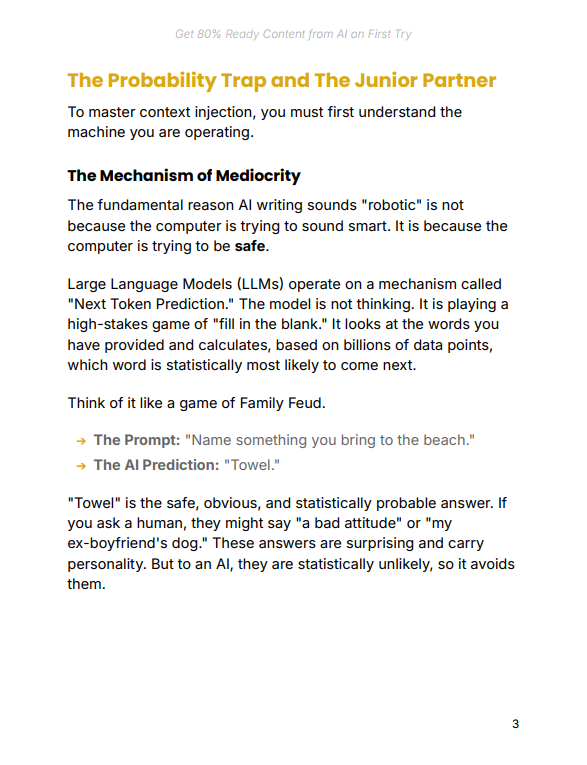

Get 80% Ready Content from AI on First Try Guide is a practical, strategy-driven playbook that shows you how to move from basic prompting to high-level creative direction. Learn how to inject context, structure inputs, and guide AI tools to produce near-finished, high-quality content on the first attempt—saving time and eliminating endless rewrites.
Context Injection frameworkto eliminate generic, robotic AI outputs.
Creative briefing techniquesthat position you as the director, not the user.
High-efficiency prompting systemsto get 80% ready content instantly.
Instant PDF download • Secure checkout • 7-day refund
This item:Get 80% Ready Content from AI on First Try Guide
$5.00Original price was: $5.00.$4.00Current price is: $4.00.
$5.00
Frequently bought together to increase results. Buy 2+ and Save 15%
Get 80% Ready Content from AI on First Try Guide teaches you how to stop generating average AI content and start directing high-quality outputs with precision. Instead of relying on basic prompts, this guide introduces a structured approach built around Context Injection, helping you control tone, depth, and direction before the AI produces a single word.
What You Get
Complete ebook (PDF)
Contents
1. The AI Content Shift: Why volume is no longer valuable
2. The Real Bottleneck: Taste, direction, and clarity
3. Understanding AI as an engine, not a creator
4. The Context Injection Framework explained
5. From prompts to creative briefs
6. Structuring inputs for precision outputs
7. Eliminating generic and cliché AI responses
8. Achieving 80% ready content on first output
Why This Guide Matters
AI has made content creation faster, but speed alone no longer creates value. Most users get stuck with generic, predictable outputs because they fail to guide the system effectively. This guide shifts your role from user to Creative Director, giving you a repeatable method to produce high-quality, structured, and usable content with minimal editing.
Features
Step-by-step frameworks for directing AI outputs
Practical examples of weak vs optimized prompts
Reusable prompt templates for different content types
Who This Guide Is For
Content creators who want faster, higher-quality outputs
Entrepreneurs using AI for marketing and communication
Professionals who need structured, reliable AI assistance
Format & Delivery
Instant PDF download after purchase. The book link is sent to your email and can also be accessed in My Books page.
Sample
Read a free sample section above.
Customer Guarantee
LearnStalk Promise: Instant PDF access • 7-day refund • Support via messaging. If you don’t see clear value, contact us and we’ll resolve it.
FAQs
How will I receive the book? Instant PDF link after purchase; check spam if you don’t see the email. It can also be accessed in My Books page.
What formats? PDF (standard).
Refunds? 7-day refund policy — contact support with your order number.
Used to determine whether a user is included in an A / B or Multivariate test.
18 months
_ga
ID used to identify users
2 years
_gali
Used by Google Analytics to determine which links on a page are being clicked
30 seconds
_ga_
ID used to identify users
2 years
_gid
ID used to identify users for 24 hours after last activity
24 hours
_gat
Used to monitor number of Google Analytics server requests when using Google Tag Manager
1 minute
_gac_
Contains information related to marketing campaigns of the user. These are shared with Google AdWords / Google Ads when the Google Ads and Google Analytics accounts are linked together.
90 days
__utma
ID used to identify users and sessions
2 years after last activity
__utmt
Used to monitor number of Google Analytics server requests
10 minutes
__utmb
Used to distinguish new sessions and visits. This cookie is set when the GA.js javascript library is loaded and there is no existing __utmb cookie. The cookie is updated every time data is sent to the Google Analytics server.
30 minutes after last activity
__utmc
Used only with old Urchin versions of Google Analytics and not with GA.js. Was used to distinguish between new sessions and visits at the end of a session.
End of session (browser)
__utmz
Contains information about the traffic source or campaign that directed user to the website. The cookie is set when the GA.js javascript is loaded and updated when data is sent to the Google Anaytics server
6 months after last activity
__utmv
Contains custom information set by the web developer via the _setCustomVar method in Google Analytics. This cookie is updated every time new data is sent to the Google Analytics server.
2 years after last activity
SourceBuster is used by WooCommerce for order attribution based on user source.
Name
Description
Duration
sbjs_first
Traffic origin information for the visitor’s first visit to your store (only applicable if the visitor returns before the session expires)
session
sbjs_current
Traffic origin information for the visitor’s current visit to your store
session
sbjs_first_add
Timestamp, referring URL, and entry page for your visitor’s first visit to your store (only applicable if the visitor returns before the session expires)
session
sbjs_current_add
Timestamp, referring URL, and entry page for your visitor’s current visit to your store
session
sbjs_migrations
Technical data to help with migrations between different versions of the tracking feature
session
sbjs_session
The number of page views in this session and the current page path
30 minutes
sbjs_udata
Information about the visitor’s user agent, such as IP, the browser, and the device type