
Lesson 1: Composition of Blood
Composition of Blood — The Body’s Transport System
Your blood travels roughly 96,000 km every day—silently delivering oxygen, nutrients, and protection. In this lesson, you will master the composition of blood (plasma + cells), the functions of each component, and the exact points examiners test in IGCSE and O Level questions.
Video Explainer
What Blood Is and Why It Matters
Blood is a fluid tissue found in animals. It flows through blood vessels and acts as the body’s delivery network—moving essential substances and removing harmful ones. In exam language, blood is described as a transport medium, but it does far more than “carry things around.”
Core idea for exams: Most blood questions are built on one pattern: structure → function → consequence.
If you can link a feature (e.g., RBC has no nucleus) to a function (more space for haemoglobin) to an outcome (efficient oxygen transport), you will score consistently.
Functions of Blood (IGCSE/O Level Standard List)
Blood performs several key functions:
- Gas exchange support: carries oxygen from lungs to cells and carbon dioxide from cells to lungs.
- Nutrient supply: delivers glucose, amino acids, vitamins, etc. to body cells.
- Waste removal: carries wastes (e.g., urea) to excretory organs such as the kidneys.
- Defense: protects against pathogens via white blood cells and antibodies.
- Temperature regulation: distributes heat and helps maintain a stable internal temperature.
- Hormone distribution: carries hormones from glands to target organs.
Composition of Blood: The Big Picture
Blood has two main components:
- Plasma — the liquid part
- Blood cells — red blood cells, white blood cells, and platelets
1. Blood Plasma (Liquid Part)
Plasma is the straw-coloured liquid in which blood cells are suspended. It is mainly water and carries dissolved substances around the body.
What plasma contains (IGCSE/O Level)
- Water (~90%)
- Plasma proteins (e.g., albumin, globulin, fibrinogen)
- Dissolved salts/ions (e.g., Na⁺, K⁺, Ca²⁺)
- Nutrients (glucose, amino acids, fatty acids, vitamins)
- Wastes (e.g., urea) and gases (CO₂, small amounts of O₂)
Why the water matters
Water in plasma acts as a solvent so substances can dissolve and move easily. It also helps regulate temperature and controls blood thickness (viscosity), which affects flow.
2. Blood Cells (Formed Elements)
Blood contains three main types of cells/particles:
- Red blood cells (RBCs / erythrocytes) — oxygen transport
- White blood cells (WBCs / leukocytes) — defense
- Platelets (thrombocytes) — clotting
Red Blood Cells (Erythrocytes): Built for Oxygen
Red blood cells transport oxygen from the lungs to body cells. Their structure is highly adapted for this job.
Key adaptations of RBCs (very common exam marks)
- Biconcave disc shape → large surface area for faster diffusion of oxygen.
- No nucleus → more space for haemoglobin.
- Contains haemoglobin → binds oxygen to form oxyhaemoglobin.
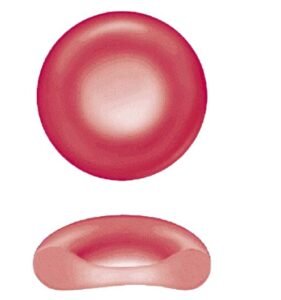
RBCs are produced in the bone marrow and live for about 120 days before being broken down (mainly in the liver and spleen).
White Blood Cells (Leukocytes): The Defense Unit
White blood cells protect the body from infections. Unlike RBCs, they have a nucleus and are generally larger.
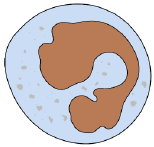
Two main groups (IGCSE/O Level)
- Phagocytes — destroy pathogens by engulfing them (phagocytosis).
- Lymphocytes — involved in producing antibodies (and coordinating immune responses).
Exam-level clarity
In IGCSE/O Level, you should confidently state:
- Phagocytes engulf and digest pathogens.
- Lymphocytes produce antibodies.
Platelets (Thrombocytes): The Clotting System
Platelets are cell fragments (not complete cells). They have no nucleus and play a central role in blood clotting. Clotting prevents excessive blood loss and blocks pathogens from entering through wounds.

Platelets are produced in the bone marrow.
High-Frequency Exam Prompts (What Examiners Love)
Answer format: Plasma + red blood cells + white blood cells + platelets.
Use: biconcave shape, no nucleus, contains haemoglobin.
Define as: the liquid part of blood that carries cells and dissolved substances.
Mention: platelets + clot formation sealing the wound.
Key Concepts
- Blood is a fluid tissue that transports substances and supports regulation and defense.
- Blood components = plasma + RBCs + WBCs + platelets.
- Plasma contains water (~90%), proteins, salts, nutrients, wastes, gases.
- RBCs (erythrocytes) transport oxygen using haemoglobin; biconcave; no nucleus; lifespan ~120 days.
- WBCs (leukocytes) defend against infection; include phagocytes and lymphocytes.
- Platelets (thrombocytes) cell fragments involved in blood clotting.
- Bone marrow produces RBCs, WBCs, and platelets.
Reflection Questions
Quick Poll
Audio Recap
Blood is a fluid tissue in animals that performs transport, regulation, and defense. It carries oxygen from the lungs to body cells and returns carbon dioxide to the lungs. It also delivers nutrients, removes wastes like urea, transports hormones, helps regulate body temperature, and protects against infection.
Blood has two main components: plasma and blood cells. Plasma is the liquid part of blood. It is mostly water, and it contains plasma proteins, dissolved salts, nutrients such as glucose and amino acids, and wastes such as urea. The blood cells include red blood cells, white blood cells, and platelets. Red blood cells transport oxygen using haemoglobin. They are biconcave, have no nucleus, and have a lifespan of about 120 days. White blood cells defend the body, including phagocytes that engulf pathogens and lymphocytes that produce antibodies. Platelets are cell fragments involved in blood clotting, which prevents blood loss and blocks pathogens from entering the body.
Flashcards
Discussion
- Write an exam-style answer: “State two functions of blood other than transport.”
- Which RBC adaptation do students forget most often, and how will you remember it in the exam?
- Give one real-life situation where clotting is essential, and explain why.
- If plasma water decreases (dehydration), what happens to blood flow and why?